Skip to content
The Kids Research Institute Australia logo
Donate

Search

Multigenerational Familial and Environmental Risk for Autism (MINERvA) Network

The MINERvA Network will allow more accurate and precise determination of the contributions of familial and environmental factors to the etiology of autism.

The associations between autistic and communication traits in parents and developmental outcomes in children at familial risk of autism at 6 and 24 months of age

Several studies have explored relationships between parent broader autism phenotype and offspring communication, and have reported that autistic-like traits in parents are related to offspring communication difficulties and autism severity. However, past research has focused on studying such associations in childhood and we know very little about them in infancy. With accumulating evidence that interventions administered during infancy may be most effective in reducing ASD symptoms, it is imperative to examine whether relationships between parent autistic-like traits and child communication appear even earlier during this critical period of life.

Validation of a novel theory of mind measurement tool: The social robot video task

Social communication difficulties in autism spectrum disorder have been associated with poor Theory of Mind (ToM), an ability to attribute mental states to others. Interventions using humanoid robots could improve ToM that may generalize to human-human interactions. Traditionally, ToM has been measured using the Firth-Happe Animations (FHA) task which depicts interactions between two animated triangles.

Mental health difficulties among trans and gender diverse young people with an autism spectrum disorder (ASD): Findings from Trans Pathways

Recent research highlights an overlap of gender diversity and autism spectrum disorders (ASD); however, data on individuals who are trans and also on the autism spectrum are largely from clinical samples and may not be representative of individuals who are trans with ASD in the general population. In addition, there is scant literature on the mental health of these individuals and their experiences in accessing gender-affirming care.

Early motor function of children with autism spectrum disorder: A systematic review

Early motor impairments have been reported in children with neurodevelopmental disorders (NDD), but it is not clear if early detection of motor impairments can identify children at risk for NDD or how early such impairments might be detected. Our aim was to characterize early motor function in children later diagnosed with NDD relative to typically developing children or normative data.

Analysis of common genetic variation and rare CNVs in the Australian Autism Biobank

Autism spectrum disorder (ASD) is a complex neurodevelopmental condition whose biological basis is yet to be elucidated. The Australian Autism Biobank (AAB) is an initiative of the Cooperative Research Centre for Living with Autism (Autism CRC) to establish an Australian resource of biospecimens, phenotypes and genomic data for research on autism.

Functioning, participation, and quality of life in children with intellectual disability: an observational study

To investigate associations between functioning, community participation, and quality of life (QoL) and identify whether participation mediates the effects of functioning on QoL.

Subgroups of Temperament Associated with Social-Emotional Difficulties in Infants with Early Signs of Autism

Links between temperament and social-emotional difficulties are well-established in normative child development but remain poorly characterized in autism. We sought to characterize distinct temperament subgroups and their associations with concurrent internalizing and externalizing symptoms in a sample of 103 infants showing early signs of autism.

Autism Research

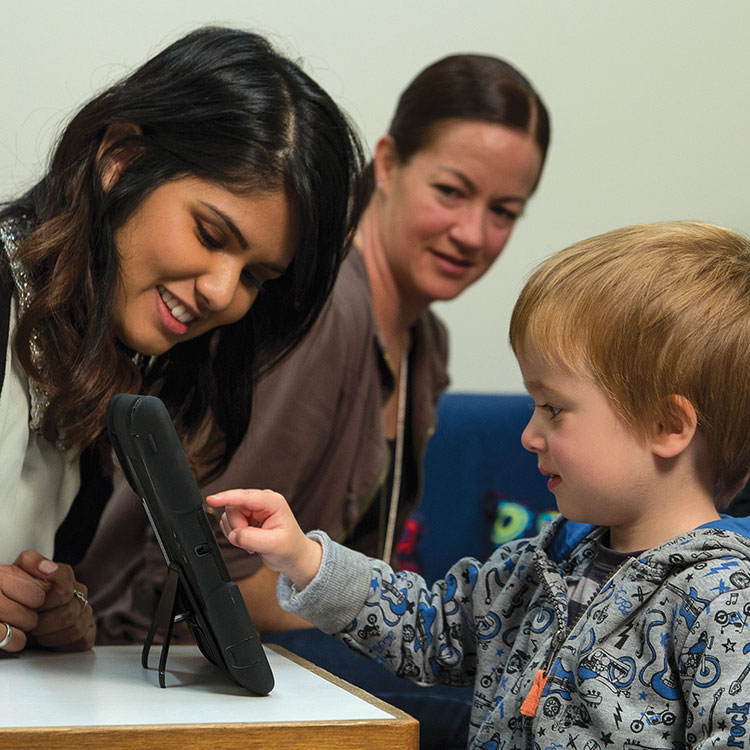
The Kids' autism research takes place at CliniKids, a centre that integrates world-class research with a clinical service for children with developmental delay and/or autism and their families.

Early biomarkers predictive of autism

This study aims to investigate the cellular and molecular profiles of the immune system in infants at high/low risk for Autism, as determined through clinical assessment.